Champions League 2026 Play-Off Draw: Benfica v Real Madrid – The Key Talking Points

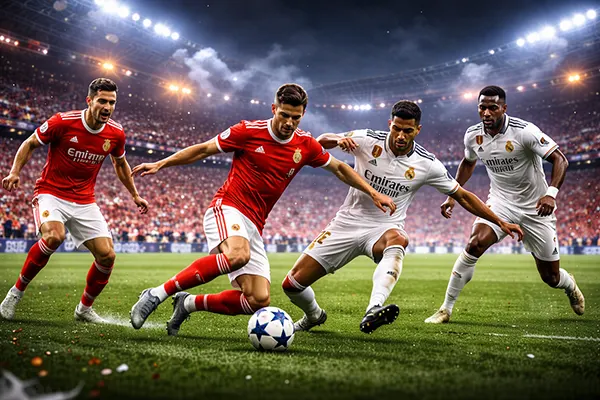
The 2025/26 Champions League knockout phase play-offs have delivered a heavyweight pairing: Benfica against Real Madrid, with the first leg in Lisbon on 17 February and the return at the Santiago Bernabéu on 25 February. Under UEFA’s revised competition format, these February fixtures have become a high-stakes gateway to the Round of 16 rather than a mere formality. This tie blends history, tactical nuance and squad management issues, making it one of the most compelling match-ups of the play-off stage.
A Modern European Rivalry with a Sharp Edge
Although not traditional rivals in the domestic sense, Benfica and Real Madrid share a rich European history stretching back to the early decades of the European Cup. Their meetings have often reflected broader shifts in continental football: Benfica’s golden eras built on academy talent and structure, and Madrid’s recurring cycles of elite-level reinvention. The 2026 play-off adds another chapter to that story.
This season’s format intensifies the narrative. The new league phase has forced top clubs to navigate a broader range of opponents, leaving little room for complacency. Benfica’s path to the play-offs required resilience against higher-ranked sides, while Madrid’s campaign exposed occasional defensive vulnerabilities despite their attacking depth.
There is also a psychological layer. Madrid remain synonymous with late drama and European pedigree, yet Benfica at the Estádio da Luz have proved capable of unsettling even the most decorated visitors. The first leg in Lisbon is not merely an opening act; it is likely to define the rhythm and emotional temperature of the entire tie.
Pressure, Pedigree and the February Factor
February football in Europe is rarely straightforward. Domestic calendars are congested, injuries accumulate, and form can fluctuate after the winter break. For Real Madrid, balancing La Liga ambitions with European demands has once again required careful squad rotation, particularly in wide areas following Rodrygo’s suspension for both legs of the tie.
Benfica, meanwhile, approach the tie with the clarity of an underdog who understands the margins. Their domestic campaign has emphasised compact defensive structure and quick transitional play. Against Madrid’s technical midfield and fluid front line, discipline without the ball will be non-negotiable.
The timing of the fixtures also magnifies the importance of the first 90 minutes. A narrow deficit may be manageable at the Bernabéu; a two-goal swing could alter the strategic landscape entirely. In modern European football, game state control is often more decisive than reputation.
Tactical Battles That Could Decide the Tie
From a tactical standpoint, the midfield duel stands out immediately. Real Madrid’s ability to circulate possession through technically gifted central players allows them to dictate tempo, but Benfica’s pressing structure has improved markedly in recent seasons. If the Portuguese side can disrupt Madrid’s build-up in advanced zones, they may generate the type of transitional chances that shift momentum.
Wide areas will also be crucial. Madrid traditionally stretch opponents with overlapping full-backs and inverted forwards cutting inside. The absence of Rodrygo alters their attacking balance, potentially encouraging a more centralised approach. That could make them predictable if Benfica compress space effectively.
Set pieces may become an underrated factor. In tightly contested European ties, corners and indirect free-kicks often determine outcomes. Benfica have shown organisation and physical presence in these situations, while Madrid’s aerial threat remains significant at both ends of the pitch.
Individual Match-Ups to Watch
Attention will naturally focus on Madrid’s leading attacking figures and whether they can impose themselves against Benfica’s centre-back pairing. The Portuguese side’s defensive unit has demonstrated composure under pressure, but containing elite movement over 180 minutes is a different challenge.
In midfield, the contest between Benfica’s ball-winning operators and Madrid’s creative distributors could shape the narrative. If Madrid are granted time between the lines, they possess the technical quality to exploit it ruthlessly. Conversely, aggressive pressing may force uncharacteristic errors.
Goalkeepers could prove decisive. Champions League knock-out football frequently hinges on one or two moments of reflex brilliance. With fine margins expected, a single save in Lisbon or Madrid might alter the psychological balance heading into the decisive stages.
What Is at Stake Beyond the Round of 16
Progression from this play-off round is about more than advancing to the next stage. Financial incentives, coefficient points and domestic momentum all ride on the outcome. For Benfica, eliminating Real Madrid would reinforce their status among Europe’s most competitive clubs and enhance the profile of their emerging talents.
For Madrid, early elimination would invite scrutiny. Their identity is closely tied to European success, and anything short of a deep run is viewed internally as a missed opportunity. The expectation surrounding the Bernabéu return leg will therefore be immense.
The broader European landscape also looms large. The new format has increased competitive density, reducing the gap between established giants and ambitious challengers. A tie of this magnitude in February illustrates how unforgiving the pathway to the final has become.
Predicted Themes Across Both Legs
Expect caution in the opening exchanges in Lisbon, with Benfica seeking controlled intensity rather than reckless ambition. Madrid, experienced in managing two-legged ties, may prioritise territorial dominance without overcommitting numbers forward.
The return leg in Spain could hinge on scenario management. If Madrid carry a positive result home, they are adept at controlling tempo and drawing opponents into uncomfortable defensive transitions. If chasing, however, Benfica have shown they can remain organised while countering at pace.
Ultimately, the Benfica v Real Madrid play-off encapsulates what the Champions League knockout stage represents in 2026: tactical sophistication, squad depth challenges and the ever-present weight of history. Over 180 minutes, the finer details – discipline, adaptability and composure under pressure – are likely to matter more than reputation alone.