WTA Finals 2026 in Riyadh: Leading Contenders and the Fight for the Rankings

The 2026 WTA season has developed into one of the most competitive campaigns in recent years. Several players have already exchanged positions at the top of the rankings, while the calendar has produced strong performances across hard, clay and indoor courts. As the WTA Finals in Riyadh approach, attention is shifting towards the race for qualification, physical preparation at the end of a demanding season, and the battle for the year-end No.1 ranking. The tournament in Saudi Arabia continues to attract global attention because it brings together the eight most consistent players of the season, many of whom arrive with realistic chances of finishing the year as the dominant figure in women’s tennis.
Aryna Sabalenka and Iga Świątek Remain the Benchmark of the Season
Aryna Sabalenka has once again demonstrated why she remains one of the most dangerous players on hard courts. Her aggressive baseline style, improved serving accuracy and willingness to attack second serves have allowed her to maintain a high winning percentage throughout 2026. Several deep runs at WTA 1000 tournaments strengthened her ranking position during the summer period, especially on fast outdoor surfaces where her power game becomes difficult to contain.
Iga Świątek, meanwhile, continues to rely on tactical discipline and exceptional movement. Although the season included several unexpected defeats against lower-ranked opponents, her consistency across multiple tournaments kept her inside the top positions of the Race to Riyadh standings. Clay remains her strongest environment, yet her improvements on quicker courts have reduced the gap between her and the most aggressive hitters on tour.
The rivalry between Sabalenka and Świątek has become central to the 2026 campaign. Their contrasting styles create some of the most technically interesting matches on the WTA calendar. Riyadh’s indoor conditions could slightly favour Sabalenka’s attacking approach, but Świątek’s ability to absorb pressure and extend rallies still gives her realistic chances of controlling long matches against heavy hitters.
The Importance of Indoor Conditions in Riyadh
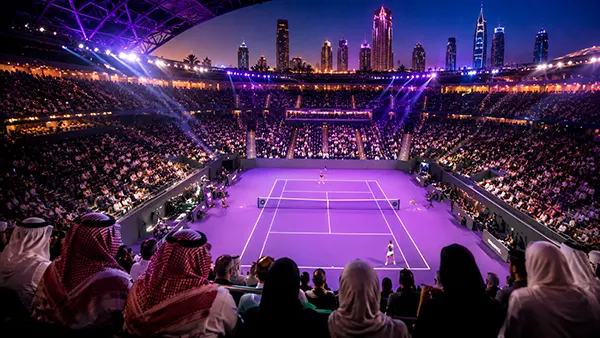
The WTA Finals court conditions in Riyadh have already become a major topic among coaches and analysts. Indoor hard courts generally reward players with strong serving patterns, quick first-strike tennis and the ability to shorten rallies. This could influence tactical decisions significantly during the group stage.
Sabalenka enters the tournament with statistical advantages in service games won and winners per match. These categories often become decisive indoors, where reaction time is reduced and returning becomes more difficult. Her willingness to attack early in rallies may help conserve physical energy during a demanding week featuring multiple elite-level opponents.
Świątek’s preparation focuses more heavily on return positioning, defensive transitions and point construction. While indoor conditions are not naturally suited to her preferred rhythm, she has improved her net play and backhand depth during 2026. Those changes may become essential against aggressive opponents who attempt to dominate shorter exchanges from the opening games.
Coco Gauff, Elena Rybakina and Qinwen Zheng Push for a Breakthrough
Coco Gauff continues to mature as one of the most complete athletes on the WTA Tour. Her movement, defensive coverage and improved serve have helped her maintain stability against top-ranked opposition. During 2026, she also displayed more confidence when finishing points at the net, reducing the pressure on long baseline exchanges that previously exposed inconsencies in forehand execution.
Elena Rybakina remains one of the most efficient players under fast conditions. Her serve placement and flat groundstrokes make her particularly dangerous indoors, where shorter rallies frequently favour players capable of controlling the first two shots of a point. Fitness management, however, remains an important factor. Several interruptions during previous seasons affected her momentum at critical stages of the calendar.
Qinwen Zheng has strengthened her position among the elite through consistent performances at major tournaments. Her physical strength, improved tactical patience and confidence in pressure moments helped her collect valuable ranking points during the Asian swing. The Chinese player appears more comfortable handling expectations compared with earlier stages of her career.
The Ranking Race Could Continue Until the Final Match
The structure of the WTA Finals means the year-end rankings often remain undecided until the closing weekend. Players earn points during both the group stage and knockout rounds, creating multiple scenarios in which the No.1 ranking can change hands inside a single tournament.
Gauff’s balanced game gives her flexibility against different playing styles. She can defend effectively against power hitters while also accelerating rallies against counterpunchers. This tactical versatility may become particularly valuable in Riyadh, where short recovery periods between matches place additional stress on physical endurance and match preparation.
Rybakina and Zheng both enter the Finals with realistic ambitions of defeating higher-ranked opponents. Indoor tournaments often produce tighter scorelines because margins become smaller on fast courts. A strong serving performance or one dominant return game can completely change the momentum of a match between elite players.
The Depth of the 2026 WTA Tour Has Increased Competition
One of the defining features of the 2026 season has been the growing depth across the women’s tour. Players ranked outside the top ten regularly reached semi-finals and finals at major tournaments, creating a more unpredictable ranking environment. Younger athletes are arriving with stronger physical preparation and fewer technical weaknesses compared with previous generations.
Jessica Pegula, Mirra Andreeva and Jasmine Paolini all produced periods of high-level tennis during the season. Their performances complicated the qualification race and increased pressure on established stars. Several tournaments featured early exits from top seeds, proving that ranking differences no longer guarantee straightforward victories on the modern WTA circuit.
The increasing balance across the tour has also raised the physical demands of the calendar. Players competing deep into tournaments almost every week face greater risks of fatigue before the Finals begin. Recovery, scheduling decisions and injury prevention now play nearly the same role as technical quality during the closing months of the season.
The WTA Finals Continue to Shape the Future of Women’s Tennis
The Riyadh edition of the WTA Finals represents more than a season-ending championship. It also reflects the broader evolution of women’s tennis, where athleticism, tactical variety and mental resilience continue to reach higher standards. The current generation combines power with improved movement and strategic awareness.
Audience interest in the tournament remains high because the Finals frequently produce matches between players who rarely meet outside Grand Slam events. Every encounter carries ranking consequences, financial significance and long-term psychological value heading into the following season. This creates an atmosphere very different from regular tour tournaments.
As 2026 approaches its final stage, the battle for the No.1 ranking remains open. Sabalenka, Świątek, Gauff and several other contenders still have opportunities to influence the final standings in Riyadh. That uncertainty adds another competitive layer to a tournament already recognised as one of the most demanding events in professional women’s tennis.