The Eight-Second Rule for Goalkeepers: How a Corner for Delay Changed Football’s Tempo
For years, football had a rule intended to prevent goalkeepers from holding the ball for too long, yet it was one of the least consistently enforced restrictions in the game. That changed in 2025, when the International Football Association Board introduced an eight-second limit backed by a much more practical sanction: if a goalkeeper keeps control of the ball with the hands or arms for too long, the opposition receives a corner. By 2026, the rule had completed its first full season in major competitions and remained part of football’s wider attempt to reduce deliberate delays. Its importance lies less in the number of corners actually awarded and more in the behaviour it encourages. Goalkeepers now know that the referee has a clear process for dealing with excessive holding, while players and spectators can see the final five seconds being counted down. The result is a simple change that has made one previously vague area of match management considerably easier to understand.
Why Football Replaced the Old Six-Second Rule
Before the change, Law 12 stated that a goalkeeper who controlled the ball with the hands for more than six seconds could be punished with an indirect free kick. On paper, that appeared straightforward. In practice, referees rarely applied it. An indirect free kick inside the penalty area could create an unusually dangerous scoring opportunity and required players to organise themselves in a crowded space close to goal. Officials therefore tended to manage delays informally rather than immediately impose the punishment. The difference between the written law and its actual application became increasingly obvious whenever a team wanted to protect a lead. A goalkeeper could catch a cross, fall to the ground, remain there for several seconds, stand up slowly and then wait before finally distributing the ball. Such periods were particularly noticeable late in matches, when every additional second helped the team that was ahead.
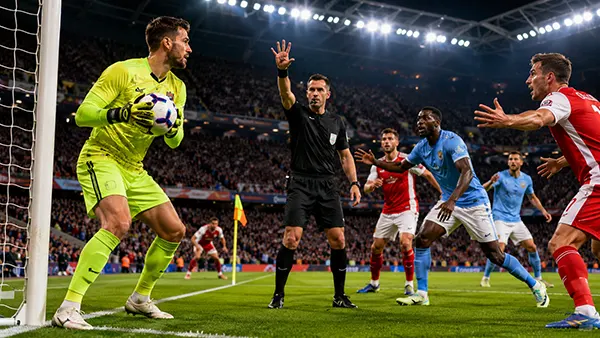
The IFAB chose to deal with this problem by changing both the permitted time and the consequence of exceeding it. The limit increased from six to eight seconds, giving goalkeepers a little more legitimate time to assess their options. In exchange, enforcement became much clearer. Once the referee judges that the goalkeeper has secure control of the ball, the eight-second period begins. During the final five seconds, the referee raises a hand and visibly counts down with the fingers. If the ball has still not been released after the permitted period, the opposing team receives a corner. The revised law entered into effect for the 2025/26 Laws of the Game from 1 July 2025, although competitions beginning earlier were permitted to introduce it in advance. It was therefore already seen at the expanded FIFA Club World Cup in June 2025.
The choice of a corner was important because it gave referees a sanction that was meaningful without creating the same complications as an indirect free kick close to goal. A corner gives possession to the opposing side in an attacking position, so a goalkeeper has a clear reason not to risk exceeding the limit. At the same time, it is a normal restart that officials and players can organise quickly. This balance helped turn a largely ignored restriction into one that could be applied consistently. The approach also survived its first season. In its March 2026 decisions concerning the 2026/27 Laws of the Game, the IFAB described the introduction of the eight-second restriction and visual countdown as successful. Rather than reversing the change, football’s lawmakers used a similar approach when approving additional measures against other forms of deliberate delay.
How Referees Apply the Eight-Second Countdown
The count does not simply begin whenever the goalkeeper touches the ball. The referee first decides that clear control has been established. Under Law 12, control includes holding the ball between the hands or arms, trapping it between a hand and another surface such as the ground or the goalkeeper’s body, carrying it on an open hand, or bouncing it on the ground. Importantly, a goalkeeper does not have to stand up before the count begins. If a keeper catches the ball safely and goes to ground without being prevented from getting up, the time can already be running. This detail closes one of the most familiar ways of slowing a match after a routine save. The first three seconds are not accompanied by the visible signal. The referee then displays the remaining five seconds, providing a warning rather than waiting until the offence has already occurred.
The countdown is intended to be practical rather than to punish a goalkeeper who genuinely cannot release the ball. Opponents are not allowed to challenge a goalkeeper who has control of the ball with the hands. If an attacking player prevents the goalkeeper from releasing it within the permitted time, the referee can award a free kick to the goalkeeper’s team unless an advantage can be played. This distinction matters after corners, crosses and other situations in which several players may still be moving through the penalty area. The keeper receives enough time to regain control of the situation, but not an unlimited opportunity to wait for the match to slow down. Team-mates also benefit from seeing the referee’s raised hand because they know immediately that they must become available for a pass or prepare for a longer distribution.
If the eight seconds expire, the resulting corner is taken from the side of the field closest to the goalkeeper’s position when the offence is penalised. The basic offence does not require a complicated restart close to the six-yard box, which was one of the weaknesses of the former system. It is also important to separate this restriction from other forms of goalkeeper possession. The eight-second count concerns control with the hands or arms inside the goalkeeper’s own penalty area. A keeper with the ball at the feet is not being timed under this particular provision, although normal laws concerning misconduct and other delays can still apply in appropriate circumstances. For spectators, this makes the rule relatively easy to follow: secure handling begins the relevant period, the raised hand provides the visible warning, and failure to release the ball results in a corner.
What the First Trials and Matches Showed About Tempo
The strongest early evidence for the rule came from the trials that preceded its adoption. More than 400 competitive matches in England, Italy and Malta were monitored, with observers recording how long goalkeepers held the ball. The number of actual violations was strikingly small. No goalkeeper exceeded eight seconds across 179 matches in Malta. Across another 160 matches in England and 80 in Italy, only five offences were recorded, occurring in four matches and always towards the end of the game. Those figures were important because the purpose of the rule was not to produce more corners. It was to make goalkeepers release the ball before a sanction became necessary. Feedback collected during the trials supported that interpretation: 72.5% of surveyed coaches, goalkeepers and referees said the game was faster, while 63.7% believed the change had a positive impact.
The trial data also helped explain why eight seconds was selected instead of retaining the old six-second limit. The IFAB found that normal goalkeeper distribution generally fitted comfortably within the longer period. During the Italian trials, keepers released the ball within four seconds on 61% of occasions. Analysis separated goalkeeper behaviour into broad patterns: very quick releases were commonly associated with attempts to start counter-attacks, while the middle part of the eight-second period gave keepers time to locate a team-mate or wait for a crowded penalty area to clear. Holding the ball beyond eight seconds was much more strongly associated with slowing the match deliberately. In some cases observed before the change, goalkeepers had retained possession for more than 20 seconds. The new limit therefore targeted the clearest delays without forcing every routine catch to become an immediate throw or kick.
Once the law reached major senior competitions, referees demonstrated that the sanction was more than a theoretical threat. At the 2025 FIFA Club World Cup, Al Hilal goalkeeper Yassine Bounou was penalised during the match against Real Madrid after retaining the ball beyond the permitted period. The Premier League soon provided another highly visible example. On 16 August 2025, Burnley goalkeeper Martin Dúbravka became the first keeper penalised under the rule in a Premier League match when referee Michael Oliver awarded Tottenham Hotspur a corner. Tottenham did not score from that restart, but the incident showed exactly why the revised law had greater practical force than its predecessor. Goalkeepers, coaches and supporters could see that officials were prepared to reach the end of the countdown and apply the specified consequence rather than simply issue repeated verbal warnings.
How the Rule Changed Goalkeeper and Team Behaviour
For goalkeepers, the biggest adjustment is not physical but organisational. After making a save, the keeper has always had to decide between a rapid counter-attack and a slower restart that allows the team to regain shape. The eight-second rule does not remove that choice, but it places a clear boundary around the second option. A goalkeeper can still wait briefly for defenders to move wider, midfielders to find passing lanes or forwards to move up the pitch. What has become much harder is extending that pause once those normal football reasons have disappeared. The visible countdown also reduces uncertainty. Rather than guessing how much patience a particular referee will show, the goalkeeper can see when the available time is running out. That encourages an earlier decision about where the next pass, throw or kick will go.
The change also affects the ten outfield players on the goalkeeper’s team. Under the older approach, defenders could sometimes walk slowly into their positions while the keeper held the ball and the referee issued informal instructions to hurry. Now the raised hand creates a shared deadline. A centre-back who wants a short pass has to move into space, a full-back must provide width promptly, and midfielders have less reason to delay their movement while waiting for the goalkeeper. When no safe short option appears, the keeper may have to choose a longer distribution rather than spend several more seconds searching for an ideal pass. This does not mean that possession-based football becomes impossible. Eight seconds is normally sufficient for a controlled restart, but it encourages the team to organise during the save and immediately afterwards instead of treating goalkeeper possession as a temporary break.
Opponents can also organise differently because the point at which the ball must return to open play is more predictable. They cannot challenge the goalkeeper while the ball is legally controlled in the hands, but they can prepare their pressing positions and anticipate likely passing options. As the visible count approaches its end, the defending side knows that distribution is imminent. This can make the transition after a save more active for both teams: one side is searching for a safe route out, while the other is deciding whether to press short options or protect space against a long release. The effect is especially relevant in the closing stages of a close match. A goalkeeper protecting a one-goal lead can no longer rely as easily on repeated long periods of possession in the hands to interrupt the opponent’s momentum and consume time without the ball being available for challenge.
Why the Rule Became Part of a Wider Fight Against Match Delays
By 2026, the most significant feature of the eight-second rule was its deterrent effect. A successful application does not necessarily mean referees should award several extra corners in every match. In fact, frequent violations could suggest that the restriction was failing to change behaviour. The original trials showed the opposite pattern: actual sanctions were rare, yet most respondents who evaluated match speed felt that the game had become faster. The goalkeeper normally released the ball before reaching the limit because conceding an attacking restart was not worth the additional few seconds. This is a useful distinction when assessing the rule. Its influence should not be measured solely by counting corners awarded for violations. The more relevant question is whether lengthy periods of uncontested goalkeeper possession have become less attractive as a deliberate method of controlling the clock.
The corner sanction also created a more proportionate relationship between the offence and the punishment. Under the six-second system, strict enforcement could hand the attacking team an indirect free kick from a very dangerous position inside the penalty area. Because that outcome could have a large influence on a match, referees often avoided reaching it. A corner is still valuable to the attacking team, particularly late in a match when the defending side wants to reduce risk, but it is a familiar part of normal play and can be restarted without an unusual cluster of players around the ball. The goalkeeper therefore faces a consequence that matters while the referee receives a sanction that is easier to administer. That combination is one reason the rule can influence behaviour even when the whistle is rarely needed.
The IFAB’s decisions for 2026/27 show how the same idea has expanded beyond goalkeeper handling. After referring to the successful introduction of the eight-second restriction, football’s lawmakers approved further measures aimed at preserving match flow. When a team deliberately delays a throw-in or goal kick, the referee can now signal a visible five-second countdown. If the delayed throw-in is still not taken when the count ends, possession can pass to the opposing team; if a deliberately delayed goal kick is not taken in time, the opposition can receive a corner. New measures also address slow substitutions and certain injury-related stoppages. These changes do not make the goalkeeper rule responsible for every later reform, but they show that its basic principle — a visible warning followed by an immediate sporting consequence — has become part of the broader approach to reducing avoidable dead time.
What Players and Supporters Should Expect in 2026/27
The eight-second restriction remains relevant in the 2026/27 season rather than being a one-year experiment. The English Football League, for example, confirmed before the 2026/27 campaign that the goalkeeper rule would continue to apply, with a corner awarded when the permitted period is exceeded. For players, this means the habits developed during 2025/26 still matter. Goalkeepers need to scan the field early, team-mates need to provide options before the final seconds disappear, and coaching staffs must treat goalkeeper possession as an active phase of play rather than guaranteed recovery time. Referees, meanwhile, have a visible tool that makes their decision easier to communicate. Even a supporter who does not know every detail of Law 12 can understand the raised hand and the countdown towards a possible corner.
There will still be situations that require judgement. A goalkeeper may catch the ball in a crowded goalmouth, collide with another player or genuinely be prevented from releasing it. The law therefore relies on the referee to decide when clear control exists and whether an opponent is interfering with distribution. That prevents the eight seconds from becoming a mechanical timer detached from what is happening on the pitch. At the same time, ordinary delaying actions after an uncontested catch are much easier to identify than under the old system. Once control is established and no opponent is stopping the release, remaining on the ground unnecessarily does not postpone the beginning of the count. This is one of the details that makes the restriction particularly relevant to late-match time management, where small pauses can accumulate and repeatedly break the rhythm of an attacking team.
The available evidence should still be interpreted with some care. The IFAB trials provide useful figures and participant feedback, and the decision to retain the rule into 2026 shows confidence in its operation, but there is not yet a single public statistic proving that every competition has gained a fixed number of extra minutes of active play because of this change alone. Football matches lose time for many reasons, including injuries, substitutions, VAR checks, goal celebrations and delayed restarts. What the eight-second rule has clearly done is remove much of the uncertainty from one specific source of delay. Goalkeepers still have enough time to make a sensible distribution decision, but they no longer have an open-ended opportunity to keep the ball safely in their hands while the match clock continues. That modest change in incentives is why a rule producing relatively few corners can still have a noticeable effect on football’s tempo.